| 3rd Generation Novas - 1968-1974 |
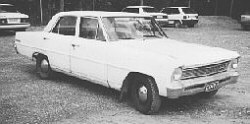
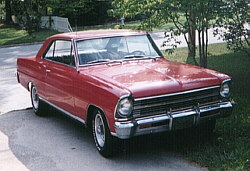
| In 1968 the Chevy II/Nova was completely redesigned. It now sported a 1st generation Camaro subframe and the popular muscle look. You can distinguish most '68-72 Novas by looking at their side marker lights, engine size label placement, and fender louvers. Although a very distinguishing charactoristic, engine size labels were only used on V8 engines, and therefor cannot always be identified. |
|
| 1968 |
The '68 is easy to recognize as a unique year. Some charactoristics associated with only '68 Novas include a Chevy II logo on the front of the hood and completely chrome headlight bezels (on most Novas). This year did not come with fender louvers. The '68 had it's V8 cubic dispacement labeled on the marker light bezel, which, for this year only, was clear, not amber. If it doesn't have louvers and the engine size is labeled on the side marker light bezel, it's a '68. The Nova script emblem was on the rear quarter panels in 1968 then moved to the fenders for the remainder years (69-79). The dash instrument cluster was also unique to 1968. The ignition key was in the dash and the heater controls were on the driver side of the steering wheel. 69-79 had the ignition in the column and the heater controls on the passenger side of the steering wheel. The tailights are split into two sections. 2/3 of each the tailight is the brake/tailight while the other 1/3 is used for the backup light. | 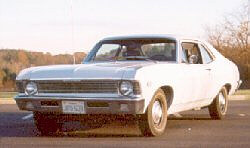 |
| 1969 |
This year the front of the hood would be adorned with the popular Bow Tie rather than "Chevy II". The headlight bezels were blackened out to match the grill. Again, you can distinguish this car by the marker bezel & louver. '69 was the first year the Nova sported some louvers on the fenders. They look kinda like fins or gills. They were, however, a standard option available only on '69-'70 Novas. Although very rare, some '69-'70 Novas can be found without louvers. Also, the side marker lights switched to amber. If the Nova has the engine size labeled on the bezel and fender louvers, it's a '69. The tailights this year were the same as the '68 | 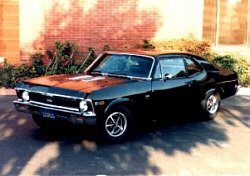 |
| 1970 |
Another unique year for the Nova. This year you can spot a few changes. Again, you can distinguish this car by the marker bezel & louver. '70 was the first year the Nova labeled the engine size above the marker light, rather than on it's bezel. The marker light was also enlongated. This is the last year the Nova would have fender louvers. If the Nova has the engine size labeled above the marker light and has fender louvers, it's a '70. Another unique feature on the front end are the signal lights (located inside the bumpers). On '68-'69 & '71-'72 Novas, these parking lights were amber in color. The '70 Nova is the only 3rd generation Nova to use clear parking light lenses. The tailights also changed. This year the entirety of the tailight would be the actual tailight, except for a small "gash" that would be used for the backup light. This tailight would remain on the Nova in '71, but change in '72. Also, the bumper turn signals were smaller on 68-69 cars (rectangle shape) while the 70-72 bumper signals were square (same width, 2x the height). | 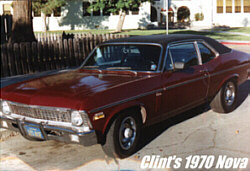 |
| 1971 |
This year their were only 2 major changes of the exterior. First, the fender louvers were dropped. Next, the parking lights were reverted to their amber-colored roots. Unfortunetly the '71 and '72 Novas are extremely similar. If the Nova has the engine size above the marker light and no fender louver it is either a '71 or a '72. The only variant between these years is in the tailights. '71 used the same tailights as in '70, with a small "gash" in the tailight for the backup light. | 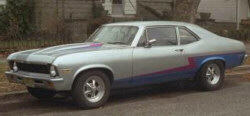 |
| 1972 |
In '72 the small "gashes" that were used for the backup lights were made taller. They now resembled squares. Therefore the only big difference between '71 and '72 was the larger backup light. | 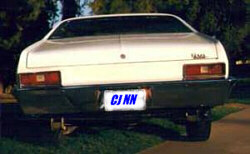 |